AI-Generated Piracy Explained: How Deepfake Streams Bypass DRM
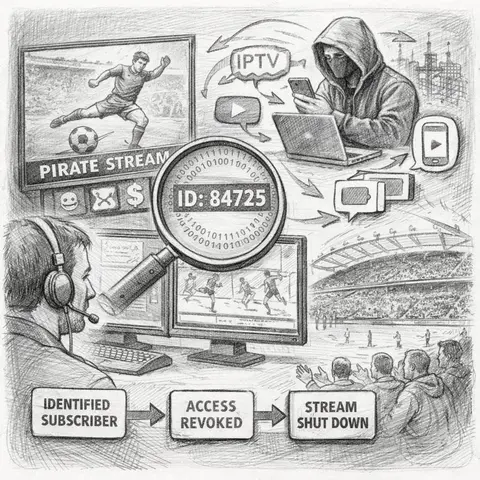
Content piracy has entered a new phase. The threat is no longer limited to stolen credentials or screen capture software—it now includes AI-generated “deepfake streams” that can mirror live broadcasts without directly redistributing the original signal.
For broadcasters and platforms, this marks a fundamental shift:
Attackers are no longer stealing streams—they are recreating them.
What Are Deepfake Streams?
A deepfake stream is an AI-assisted reproduction of a live broadcast that mimics the original content closely enough to be commercially valuable, while avoiding traditional DRM and watermarking controls.
These streams may:
Reconstruct video frames using AI interpolation
Clone audio commentary and crowd noise
Replace protected segments with AI-generated equivalents
Mirror gameplay or sports footage with minimal perceptual loss
The result is a stream that looks legitimate, runs in real time, and never contains the original protected video.
Why Traditional DRM Fails Against AI-Based Piracy
DRM systems are designed to protect encrypted content, not synthetic reproductions.
DRM Control
Effective Against
Ineffective Against
Encryption
Raw stream theft
AI recreation
License checks
Unauthorized players
AI-generated video
Secure playback
Screen capture
Model-based rendering
Key rotation
Replay attacks
Synthetic streams
Once AI enters the pipeline, DRM enforcement boundaries dissolve.
Core Techniques Used in AI-Generated Piracy
1. AI-Assisted Screen Capture Enhancement
Attackers still start with screen capture—but AI removes its weaknesses.
The resulting stream feels authentic—even to experienced viewers.
4. Unauthorized AI-Powered Mirror Sites
Instead of embedding stolen streams, attackers now operate AI mirror platforms:
Ingest protected streams briefly
Extract metadata and event structure
Generate AI-based mirrors
Serve content from clean infrastructure
This allows:
Rapid domain rotation
CDN-scale delivery
Reduced takedown effectiveness
Why Watermarking Alone Is Not Enough
Forensic watermarking remains critical—but AI weakens its reach:
AI reconstruction destroys embedded watermark signals
Synthetic frames contain no original watermark
Attribution becomes probabilistic instead of deterministic
This forces defenders to correlate multiple signals, not rely on a single marker.
Emerging Detection Strategies
1. Behavioral Stream Analysis
Instead of looking for copied pixels, platforms analyze:
Camera transition timing
Latency patterns
Crowd reaction delays
Inconsistent graphical overlays
AI-generated streams often exhibit non-human timing artifacts.
2. Synthetic Content Fingerprinting
Broadcasters now fingerprint:
Event sequences
Play timing
Audio cadence
Visual structure
This allows detection of structurally identical but visually different streams.
3. Real-Time AI vs AI Defense
The arms race has gone fully autonomous:
Pirate AI → Synthetic streamDefender AI → Anomaly detection → Automated takedown
Human review is no longer fast enough for live events.
Legal and Regulatory Challenges
AI-generated piracy complicates enforcement:
No direct copyright infringement of original frames
Jurisdictional ambiguity
Difficulty proving “substantial similarity”
Automated infrastructure with no identifiable operators
Existing copyright frameworks were not designed for synthetic media theft.
Strategic Implications for Broadcasters
To remain resilient, content owners must:
Combine DRM + watermarking + AI detection
Monitor event-level behavior, not just streams
Automate incident response
Treat piracy as an adversarial ML problem
This is no longer just media security—it's AI security.
The Road Ahead
Deepfake streams represent a turning point. As AI models become faster and cheaper, piracy will shift further away from theft and closer to real-time imitation.
The winners in this next phase will be those who understand one core truth:
You cannot protect content by defending files—you must defend reality itself.
For broadcasters, that means fighting AI with AI, and doing it at live-event speed.
 ai-security