Technical, Administrative, and Physical Controls: The Operational Differences
Security controls are the safeguards and countermeasures prescribed for an information system or an organization.
These measures are designed to protect the confidentiality, integrity, and availability of information.
To design a comprehensive security posture, organizations categorize these controls based on their operational domain.
The three primary classes of security controls are technical, administrative, and physical.
While all three share the ultimate goal of mitigating risk, they differ significantly in how they are implemented, how they operate, and how they respond to threats.
Understanding these operational differences is crucial for security architects, chief information security officers, and risk managers.
This article provides an in-depth exploration of these three control categories, their operational mechanics, and how they function together in a defense-in-depth model.
Technical Controls
Technical controls, also known as logical controls, are security countermeasures implemented through hardware, software, or firmware.
These controls protect systems, networks, and data by executing automated rules, enforcing access boundaries, and monitoring digital behavior.
How Technical Controls Work
Technical controls operate at the logical layer of an information system.
They are executed by computers, operating systems, and network devices based on predefined mathematical algorithms and logic rules.
When a user attempts to access a resource, technical controls intercept the request and evaluate it against security policies.
For example, a firewall examines network packet headers and compares them to an access control list to determine whether to allow or drop the traffic.
Similarly, encryption algorithms transform plaintext data into unreadable ciphertext to prevent unauthorized disclosure, regardless of where the data resides.
Common examples of technical controls include:
Identity and Access Management (IAM): Multi-Factor Authentication (MFA), role-based access control, and directory services.
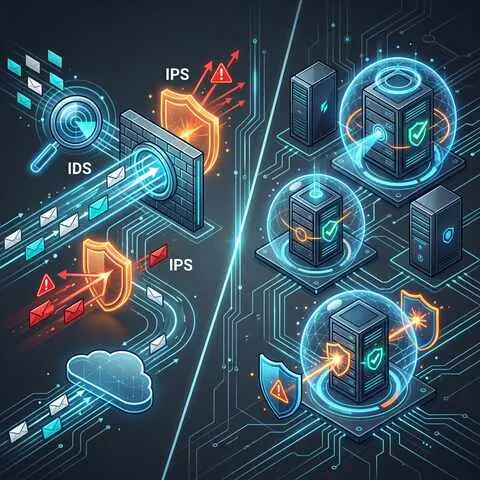
Network Security: Firewalls, Intrusion Detection and Prevention Systems (IDS/IPS), and Virtual Private Networks (VPNs).
Data Protection: Symmetric and asymmetric encryption, hashing, and digital signatures.
Endpoint Security: Antivirus software, Endpoint Detection and Response (EDR) agents, and host-based firewalls.
Vulnerability Management: Automated scanners and patch management software.
Strengths of Technical Controls
The primary strength of technical controls is their operational speed.
Because they are executed by processors, technical controls can make access decisions and block threats in milliseconds.
They operate continuously without human fatigue, ensuring constant protection.
Furthermore, technical controls provide highly precise, rule-based enforcement that leaves no room for human interpretation.
They are also highly scalable, allowing an organization to secure millions of endpoints or transactions using the same policy framework.
Finally, technical controls generate detailed digital logs, which are essential for forensic investigation and real-time monitoring.
Limitations of Technical Controls
Despite their efficiency, technical controls suffer from inherent limitations.
They are highly complex, which makes them susceptible to misconfiguration and software bugs.
A single syntax error in a firewall rule or a vulnerability in an operating system kernel can render technical controls useless.
They are also rigid; they cannot adapt to novel scenarios or exercise human judgment.
For instance, an automated system might block a legitimate business transaction because it matches a signature of an attack, causing a false positive.
Additionally, technical controls are expensive to acquire, license, configure, and maintain.
Lastly, they cannot prevent attacks that bypass the logical layer entirely, such as a social engineer convincing a user to reveal their password over the phone.
Administrative Controls
Administrative controls, also known as managerial or operational controls, are safeguards that focus on human behavior, organizational processes, and business operations.
These controls are defined in written documents and enforced through management oversight, legal mechanisms, and organizational culture.
How Administrative Controls Work
Administrative controls operate at the organizational and behavioral level.
They establish the rules of engagement for how employees, contractors, and partners interact with technology and data.
Instead of using software to block an action, administrative controls use policies, guidelines, and procedures to instruct humans on what they should or should not do.
Compliance is monitored through audits, performance reviews, and supervisory oversight.
When a violation occurs, the response is typically disciplinary or legal rather than digital.
For example, a policy might forbid employees from using personal USB drives on company laptops.
While a technical control could block the USB port, the administrative control defines the rule, explains the risk, and establishes the consequences of non-compliance.
Common examples of administrative controls include:
Security Policies and Standards: Acceptable Use Policies (AUP), information security policies, and password complexity guidelines.
Human Resources Security: Background checks, onboarding clearance, and mandatory annual security awareness training.
Compliance and Auditing: Internal and external audits, risk assessments, and compliance reporting.
Vendor Management: Service Level Agreements (SLAs), non-disclosure agreements, and third-party risk assessments.
Strengths of Administrative Controls
Administrative controls are the foundation of any security program because they align security goals with business objectives.
Their greatest strength is their ability to address the human element of security.
By educating employees on phishing and social engineering, administrative controls mitigate threats that technology cannot detect.
They are also highly flexible; policies can be updated to address new business operations or legal requirements without changing underlying software architectures.
Furthermore, administrative controls are relatively inexpensive to design compared to complex technical systems, as they primarily require human time and organizational alignment.
They also provide the legal framework necessary to prosecute insider threats or hold third-party vendors accountable for breaches.
Limitations of Administrative Controls
The most significant limitation of administrative controls is their reliance on human compliance.
Humans are prone to distraction, fatigue, and errors, which makes administrative controls inherently unreliable.
A policy is only effective if employees read it, understand it, and choose to follow it.
Moreover, the operational latency of administrative controls is extremely high.
If an employee violates a policy, it may take weeks or months for an auditor to detect the breach, and the damage may already be done.
Enforcement is also difficult and subjective, leading to inconsistent application of rules across different departments.
Finally, administrative controls cannot stop an active, automated digital attack in real time.
A policy document cannot block a ransomware payload from executing once a user clicks a malicious link.
Physical Controls
Physical controls are tangible countermeasures designed to prevent, detect, and respond to unauthorized physical access to assets, personnel, and facilities.
These controls protect the physical infrastructure that hosts the organization's technical systems and data.
How Physical Controls Work
Physical controls operate in the material world.
They manipulate physical space to delay, block, or monitor the movement of people and equipment.
These controls establish concentric rings of security around critical assets.
For example, the outermost ring might be a perimeter fence, followed by a locked building door, a badged server room entry, and finally a locked equipment rack.
Physical controls use physical materials, mechanical locking mechanisms, and environmental sensors to enforce boundaries.
When a physical breach occurs, the control either physically blocks the intruder or triggers an alarm that alerts security personnel to intervene.
Common examples of physical controls include:
Perimeter Defense: Fences, gates, security guard posts, and active vehicle barriers.
Access Points: Smartcard readers, biometric scanners, mechanical locks, and turnstiles.
Surveillance and Detection: Closed-Circuit Television (CCTV) cameras, motion detectors, and glass-break sensors.
Environmental Controls: Fire suppression systems, Heating, Ventilation, and Air Conditioning (HVAC) systems, and Uninterruptible Power Supplies (UPS).
Asset Protection: Secure server racks, cable locks, and secure media destruction facilities.
Strengths of Physical Controls
Physical controls provide direct, tangible protection that digital tools cannot duplicate.
They prevent adversaries from gaining direct physical access to servers, which is critical because physical access almost always guarantees logical compromise.
For instance, if an attacker can touch a server, they can bypass technical controls by rebooting the system into single-user mode or inserting a malicious USB device.
Physical controls are also highly visible, acting as a strong psychological deterrent to opportunistic criminals.
Additionally, environmental controls protect hardware from natural disasters, power failures, and overheating, ensuring the availability of operations.
They are durable and long-lasting, often requiring minimal updates once installed compared to constantly evolving software systems.
Limitations of Physical Controls
The primary limitation of physical controls is their high capital expenditure (CapEx).
Installing fences, biometric scanners, and surveillance networks requires significant upfront investment and ongoing maintenance.
They also depend heavily on human response.
A surveillance camera can only record a breach; it cannot stop an intruder unless security guards are deployed to respond to the alarm.
Physical controls can also be bypassed through social engineering, such as an attacker tailgating an authorized employee through a secure gate.
Furthermore, physical controls are static; they cannot easily adapt to changing organizational structures or remote work models.
Lastly, physical controls offer no protection against remote cyberattacks, database injections, or network-based data exfiltration.
Operational Differences: A Comparative Analysis
While technical, administrative, and physical controls are all necessary, they differ fundamentally across several operational dimensions.
These dimensions include speed of action, level of automation, resource costs, and failure modes.
1. Speed of Response
The operational speed of a control determines how quickly it can react to an ongoing security event.
Technical controls are the fastest, operating at machine speed to block packets or terminate sessions.
Physical controls operate at human speed; they physically block access immediately, but their detection and response rely on guards traveling to the site of an alarm.
Administrative controls are the slowest, operating at organizational speed.
Detecting a policy violation or updating a procedural standard can take days, weeks, or even months.
2. Level of Automation
Automation defines how much human intervention is required to maintain the control.
Technical controls are highly automated, running continuous processes with minimal human oversight once configured.
Physical controls are semi-automated, relying on mechanical locks and sensor alarms, but still requiring human monitoring of camera feeds and physical patrols.
Administrative controls have the lowest level of automation, relying entirely on manual management reviews, employee compliance, and human audits.
3. Resource Allocation: CapEx vs. OpEx
The financial model of each control category impacts organizational budgeting.
Physical controls require high Capital Expenditure (CapEx) for building infrastructure, purchasing hardware, and installing security systems.
Technical controls require a mix of CapEx and Operational Expenditure (OpEx), involving software license renewals, cloud subscription fees, and engineering maintenance.
Administrative controls are primarily OpEx, representing the salaries of policy authors, trainers, compliance auditors, and the time employees spend attending training sessions.
4. Failure Modes and Resilience
Every security control will eventually fail, but the manner in which they fail is different.
When a technical control fails, it often does so silently due to a logic bug or a software crash, potentially leaving systems open without generating an alert.
When a physical control fails, it is usually obvious, such as a broken lock or a power outage, which immediately triggers a physical response.
When an administrative control fails, it is due to human non-compliance or error, which requires management intervention and disciplinary action rather than a technical patch.
Comparative Table: Operational Dimensions
Operational Dimension
Technical Controls
Administrative Controls
Physical Controls
Operational Layer
Logical / Digital
Human / Organizational
Physical / Material
Response Time
Milliseconds (automated)
Days to Months (procedural)
Seconds to Minutes (human response)
Automation Level
High
Low
Medium
Primary Resource
Software / Firmware
Time / Documentation
Infrastructure / Hardware
Cost Type
Mixed (CapEx & OpEx)
Operational (OpEx)
Capital (CapEx)
Failure Detection
Log analysis / Alerts
Audits / Incidents
Physical inspection / Alarms
Primary Focus
Data / Systems / Networks
People / Policy / Compliance
Buildings / Hardware / Facility
Functional Roles: Preventative, Detective, and Corrective
To fully understand the operational differences, it is helpful to look at how these controls align with functional security classifications.
All controls, whether technical, administrative, or physical, perform one of three primary functional roles: prevention, detection, or correction.
1. Preventative Controls
Preventative controls act as active barriers to stop a threat from occurring.
Technical preventative controls include firewalls that block malicious ports and MFA systems that deny access to unauthenticated users.
Administrative preventative controls include pre-employment background screening and mandatory onboarding safety training.
Physical preventative controls include mantraps, security gates, and biometric door locks.
2. Detective Controls
Detective controls identify when a security event is occurring or has already occurred.
Technical detective controls include Host IDS (HIDS) agents that monitor file integrity and security information tools (SIEM) that flag abnormal traffic patterns.
Administrative detective controls include compliance audits and financial reviews that identify internal fraud.
Physical detective controls include motion-activated surveillance cameras and security guards patrolling the facility grounds.
3. Corrective Controls
Corrective controls repair damage, restore services, and mitigate further risk after a threat has bypassed preventative measures.
Technical corrective controls include antivirus software quarantine procedures and automated failover scripts that route traffic to backup databases.
Administrative corrective controls include executing the incident response plan and issuing disciplinary warnings to policy violators.
Physical corrective controls include automatic fire suppression systems and backup generators that restore power to critical equipment racks.
Synergy: The Defense-in-Depth Model
No single control class is sufficient to secure an enterprise.
Relying solely on technical controls leaves an organization vulnerable to social engineering and physical theft.
Relying solely on administrative controls fails to stop automated attacks in real time.
Relying solely on physical controls does not protect against remote hackers.
Therefore, a resilient security architecture combines all three classes into a Defense-in-Depth model.
This model ensures that if an attacker successfully bypasses one layer of defense, other controls are in place to delay, detect, and stop them.
Scenario: Securing Sensitive Customer Data
Consider how an organization secures its database hosting sensitive customer information using all three control classes:
Administrative layer: The organization establishes a strict data privacy policy that defines who is authorized to view customer data.
Employees must sign non-disclosure agreements and complete annual privacy training to understand their obligations.
Physical layer: The physical database servers are housed in a secure data center facility.
Access to the facility requires passing a security desk, scanning a biometric credential, and entering a locked server enclosure monitored by CCTV cameras.
Technical layer: Within the server, access is restricted using role-based access control and MFA.
The database traffic is encrypted in transit and at rest, and all access attempts are logged to a central monitoring system.
If an external hacker attempts a remote attack, the technical firewall and encryption controls protect the data.
If an insider threat attempts to walk into the server room and steal a hard drive, the physical door locks and security guards stop them.
If a customer service agent tries to look up records they do not need, the administrative policy defines this as a violation, and the system log records the event for disciplinary review.
Conclusion
Technical, administrative, and physical controls represent the three pillars of a balanced information security program.
Their operational differences make them complementary rather than redundant.
Technical controls offer the rapid speed and automation necessary to counter modern digital threats.
Administrative controls provide the organizational governance, policies, and human risk management needed to align security with the business.
Physical controls establish the tangible boundaries that protect physical infrastructure from theft and environmental hazards.
By understanding the strengths, limitations, and operational boundaries of each control type, organizations can design a comprehensive defense-in-depth strategy.
This balanced approach ensures that people, processes, and technology work in harmony to build a resilient security posture.
 Cybersecurity